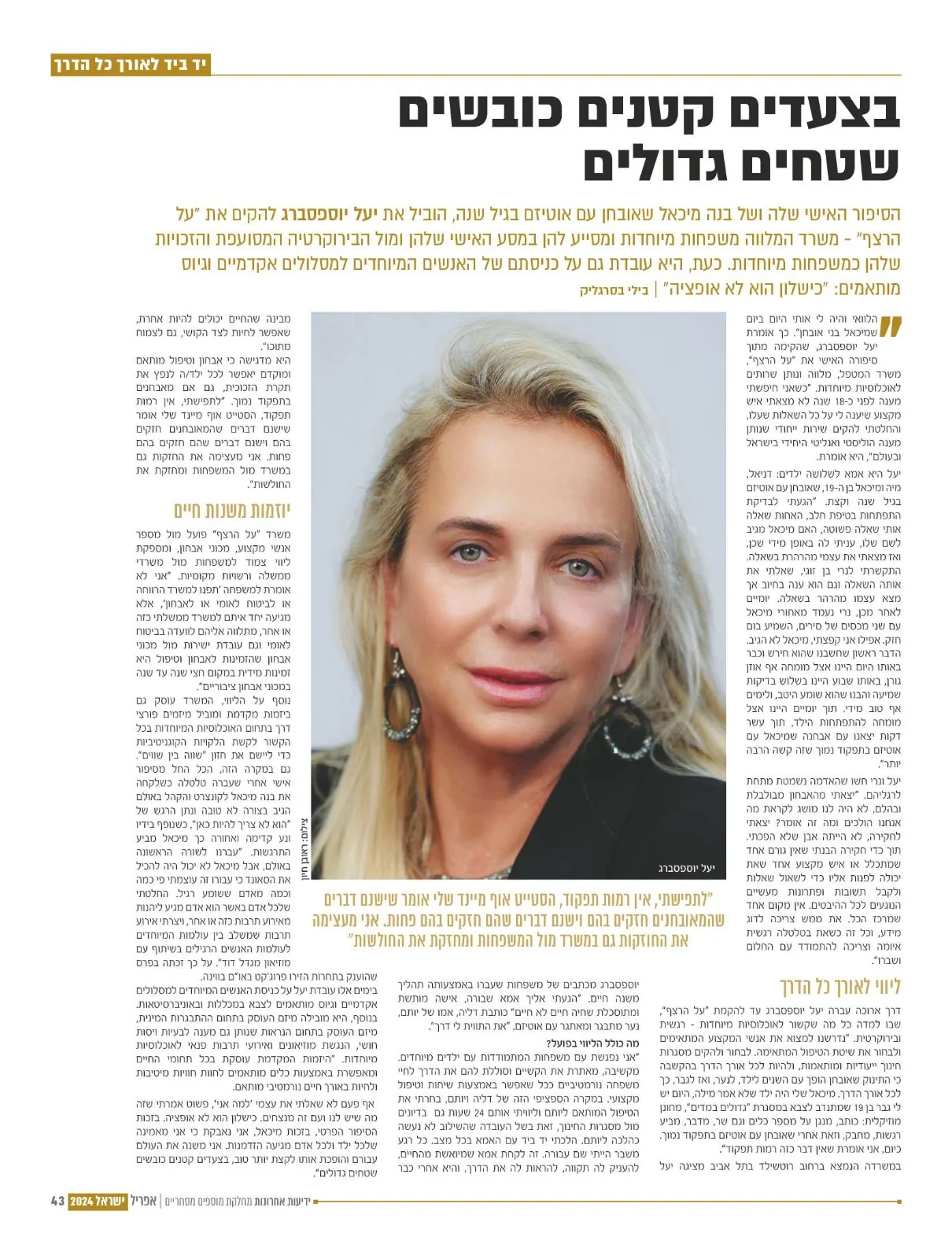
“With small steps we conquer great territories.”
How Yael Josephsberg's personal journey as the mother of a son on the autism spectrum became Al HaRetzef — an office that walks alongside special-needs families through bureaucracy, rights, and the institutions around them.
Yael Josephsberg's personal story as the mother of a son with autism led her to found Al HaRetzef — an office that accompanies special-needs families and helps them navigate bureaucracy and access their rights. Today she also works to make academic institutions and public services accessible to people with disabilities.
“Failure is not an option.”
Yael is the mother of three, including a son diagnosed with autism at a young age. About 18 years ago — before autism awareness and services were as developed as they are today — she found herself searching alone for answers and support.
She describes the diagnosis as a life-changing event: “It affects not only the child, but the entire family — parents, siblings, grandparents. Everyone goes through a process.” The confusion and uncertainty that followed, and the difficulty of finding reliable guidance, convinced her that families need far more than clinical treatment. They need someone who understands the systems, the rights, the services, and the emotional weight of it all.
Over time she built deep knowledge of the systems around special-needs services and began helping other families facing similar challenges. “I understood that if I wanted my child to receive everything he deserved, I would have to become his advocate and fight for every right available to him.”
Al HaRetzef was founded to provide comprehensive support for families of children and adults with special needs. The goal is to make the process less overwhelming, and to ensure that families receive every service and benefit to which they are entitled.
A central belief running through Yael's work is that every person deserves solutions tailored to their unique needs.
“Adaptation is not a luxury — it is a necessity.”
When environments, services and systems are adapted properly, she argues, people with disabilities can take part fully in society and realise their potential.
Beyond individual family support, Yael works to advance broader social change — emphasising that inclusion benefits society as a whole.
Accessibility in public institutions
Working with cultural, civic and academic institutions to make their spaces and services genuinely accessible.
Inclusive education
Promoting inclusive practice across the education system — in policy, in classrooms, and in everyday school life.
Higher education & employment
Supporting integration into academic studies and into meaningful work suited to each person's abilities.
Awareness of rights
Raising awareness of the benefits, services and rights available to people with disabilities and their families.
Many families, Yael says, are unaware of the benefits, services and rights available to them. Helping them understand and exercise those rights is one of her central goals.
“When families receive the support they deserve, their quality of life improves dramatically.”
Knowledge, she believes, empowers families — freeing them to focus on growth and development rather than a constant fight with bureaucracy.
Despite the challenges she has faced personally and professionally, Yael remains hopeful, and her message to families is to keep going.
“Every child has strengths. Every family can move forward. Progress may come in small steps — but those small steps conquer great territories.”
Her vision is a society in which people with disabilities are treated with dignity, given equal opportunities, and fully included in community life.
“There are no impossible dreams. When we remove barriers and make the necessary adaptations, people can flourish. I empower families and strengthen the rights of people with special needs.”